Perfect performance
Ham correctly performed his lever-pulling tasks 50 out of 50 times during the flight, despite experiencing 14.9g forces during re-entry.
The heroic chimpanzee who blazed a trail into space, making history on January 31, 1961.
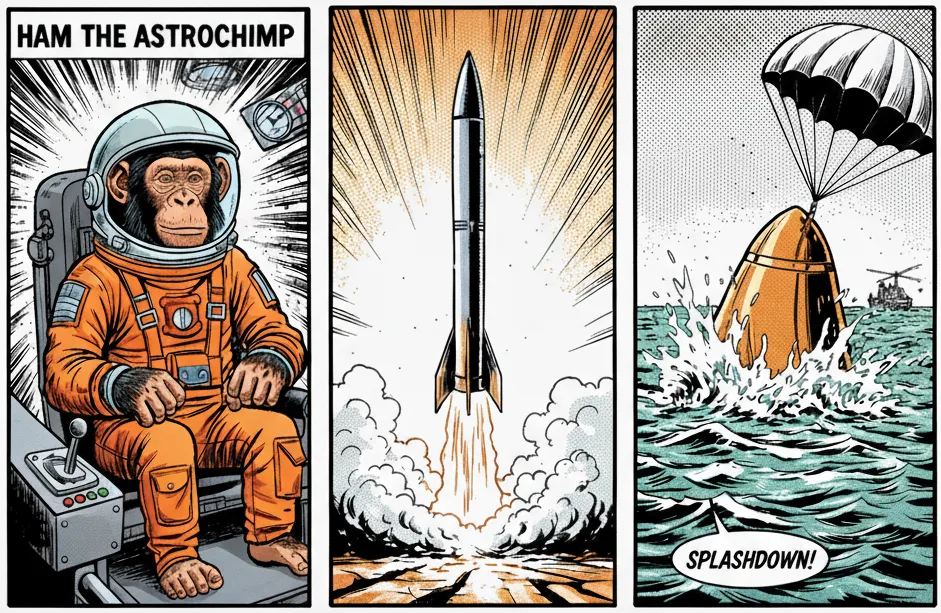
Born in the French Cameroon, West Africa, Ham (originally named #65) was captured as an infant and brought to the United States for the space program.
Selected from 40 chimpanzee candidates at Holloman Air Force Base in New Mexico, Ham underwent intensive training to perform tasks during spaceflight.
Ham flies aboard the Mercury-Redstone 2 (MR-2) mission, launched from Cape Canaveral, Florida.
After his historic flight, Ham lived at the National Zoo in Washington, D.C., where he became a beloved celebrity and inspired countless visitors.
Ham spent his final years at the North Carolina Zoological Park in Asheboro, where he lived peacefully until his death on January 19, 1983, at age 25.
Ham became the first hominid to travel to space aboard the Mercury-Redstone 2 (MR-2) mission, launched from Cape Canaveral, Florida.
During the flight, Ham performed tasks such as pushing levers in response to lights, demonstrating that complex actions could be performed in space. His successful mission paved the way for Alan Shepard's historic flight just three months later.
Ham's courage and successful mission proved that living beings could survive the harsh conditions of spaceflight, including weightlessness and high g-forces. His contributions were essential to the Mercury program and humanity's journey to the stars.
Originally referred to only by his number (65) to avoid public attachment in case of mission failure, he was named "Ham" after the mission's success—an acronym for Holloman Aerospace Medical Center.
Today, Ham is remembered as a true pioneer of space exploration, a hero who helped make human spaceflight possible. His skeleton is preserved at the National Museum of Health and Medicine, and his contributions will never be forgotten.
Learn more about Ham's incredible story and the ongoing work to protect chimpanzeesSave the Chimps — Ham's story ↗
Ham correctly performed his lever-pulling tasks 50 out of 50 times during the flight, despite experiencing 14.9g forces during re-entry.
Ham was rewarded with food pellets and banana pellets for correct responses during training, and received a mild electric shock for incorrect or slow responses.
After his flight, Ham became an international celebrity, appearing on television and receiving fan mail from around the world.
Ham's capsule landed 130 miles off course and took on water before rescue. He was reportedly happy to see the recovery ship!
The famous photo of Ham shaking hands with the commander of the recovery ship became an iconic image of the space race.
Ham's successful flight gave NASA the confidence to send Alan Shepard into space just 11 weeks later on May 5, 1961.
Ham's courage and sacrifice helped pave the way for space exploration. Honor his memory by supporting organizations that protect and care for chimpanzees and animals in need.